Singapore Mahjong rules reference
Singapore Mahjong winning hands & combinations
To win on this Singapore Mahjong app, an ordinary hand needs four sets, one pair and at least 1 Tai. A zero-Tai Chicken Hand cannot Hu. Compatible patterns stack, but payout is capped at 5 Tai; Thirteen Wonders and automatic wins are the main exceptions to the normal shape.
This focused chart documents the exact rules used by the playable WongHongWei.com table. Singapore Mahjong varies between families and groups, so use these values in the app and confirm differences before physical play.
Written by Wong Hong Wei · Editorially reviewed
Review boundary: app-specific results are checked by deterministic tests. Independent Mahjong-expert and fluent Chinese-language review remain pending; see publication status.
The basic Singapore Mahjong winning shape
Most wins use 14 regular tiles arranged as four sets and one eye pair. A set is a Chow of three consecutive suited tiles, a Pong of three identical tiles, or a Kong of four identical tiles. A Kong still occupies one set position because its declaration gives a replacement draw.
Shape alone is not enough here. The completed hand must find at least one recognised Tai source: a named pattern, a valued Dragon or Wind set, a qualifying bonus tile, or a +1 win circumstance. Four sets and a pair worth zero Tai are a Chicken Hand 雞胡 and cannot win. Seven Pairs 七對 is a known variant, but this practice app does not recognise it.
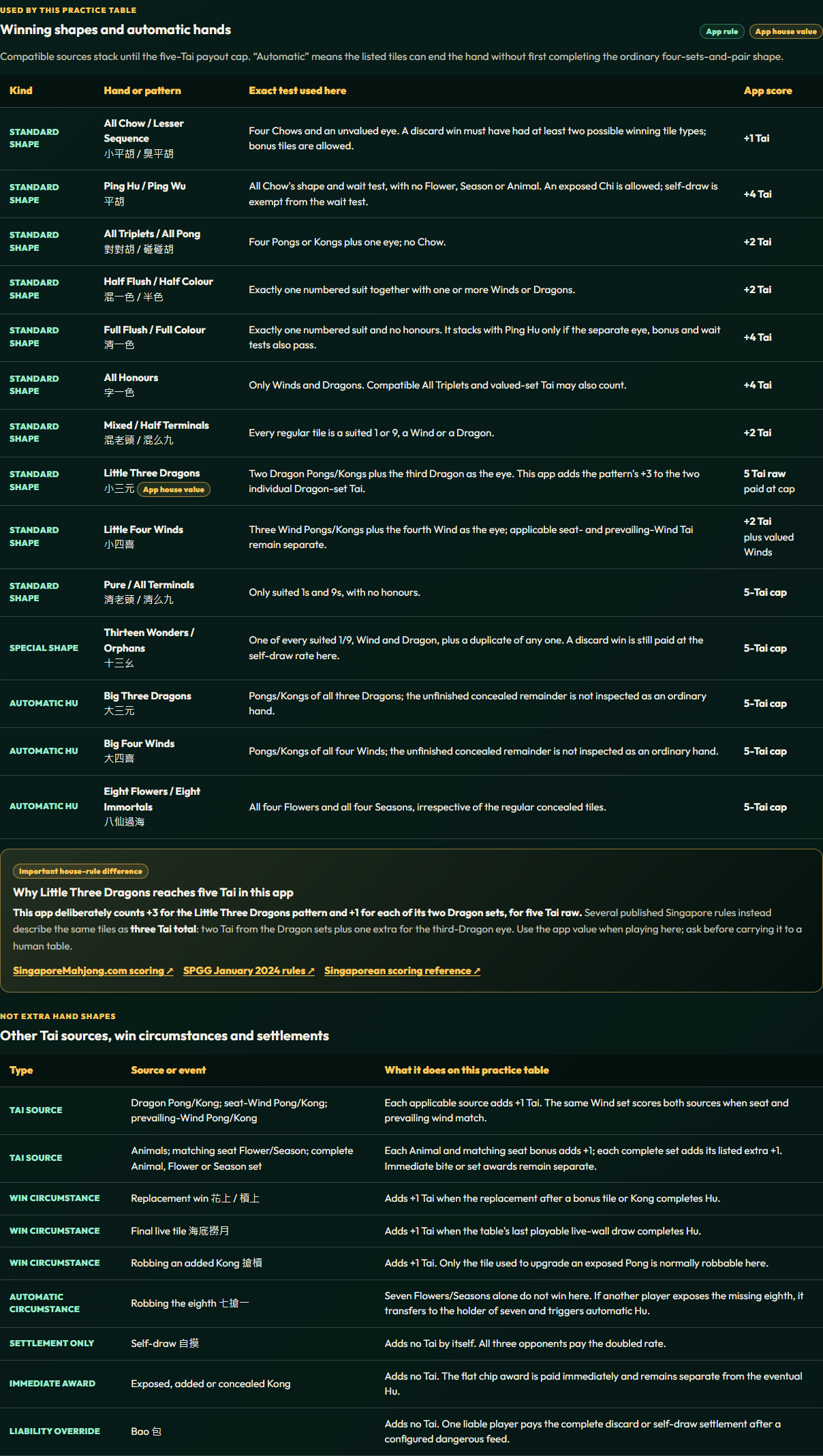
Winning hands and Tai values used by this app
The score column shows each named pattern's contribution. Compatible sources combine until the app's five-Tai payout cap. “Automatic Hu” means the listed tiles can end the hand without first completing the ordinary four-sets-and-pair shape.
| Winning hand | Exact app test | Value |
|---|---|---|
| All Chow / Lesser Sequence 小平胡 / 臭平胡 | Four Chows and an unvalued eye. A discard win needs at least two possible winning tile types. Bonus tiles are allowed. | +1 Tai |
| Ping Hu / Ping Wu 平胡 | All Chow's shape and wait test, with no Flower, Season or Animal. Exposed Chi is allowed; self-draw is exempt from the wait test. | +4 Tai |
| All Triplets / All Pong 對對胡 / 碰碰胡 | Four Pongs or Kongs plus one eye, with no Chow. | +2 Tai |
| Half Flush / Half Colour 混一色 / 半色 | Exactly one numbered suit together with one or more Winds or Dragons. | +2 Tai |
| Full Flush / Full Colour 清一色 | Exactly one numbered suit and no honours. It stacks with Ping Hu only when the separate eye, bonus and wait tests pass. | +4 Tai |
| All Honours 字一色 | Only Winds and Dragons. Compatible All Pong and valued-set Tai may also count. | +4 Tai |
| Mixed / Half Terminals 混老頭 / 混么九 | Every regular tile is a suited 1 or 9, a Wind or a Dragon. | +2 Tai |
| Pure / All Terminals 清老頭 / 清么九 | Only suited 1s and 9s, with no honours. | 5-Tai cap |
| Little Three Dragons 小三元 App house value | Two Dragon Pongs or Kongs plus the third Dragon as the eye. The pattern and two Dragon sets stack here. | 5 Tai raw; paid at cap |
| Little Four Winds 小四喜 | Three Wind Pongs or Kongs plus the fourth Wind as the eye. Applicable seat- and prevailing-Wind Tai stay separate. | +2 Tai, plus valued Winds |
| Thirteen Wonders / Orphans 十三幺 | One of every suited 1 and 9, Wind and Dragon, plus one duplicate of those thirteen tile types. | 5-Tai cap; self-draw rate |
| Big Three Dragons 大三元 | Pongs or Kongs of all three Dragons. | Automatic Hu; 5-Tai cap |
| Big Four Winds 大四喜 | Pongs or Kongs of all four Winds. | Automatic Hu; 5-Tai cap |
| Eight Flowers / Eight Immortals 八仙過海 | All four Flowers and all four Seasons. | Automatic Hu; 5-Tai cap |
Little Three Dragons: five Tai here, three in cited rulesets
This app deliberately scores Little Three Dragons as +3 for the pattern, plus +1 for each of its two Dragon sets: 3 + 1 + 1 = 5 Tai. Several published Singapore rules instead describe the same tiles as three Tai total—two from the Dragon sets and one extra for the third-Dragon eye.
The tiles are two Dragon Pongs or Kongs and a pair of the remaining Dragon. For example: a Red Dragon Pong, a Green Dragon Pong and White Dragons as the eye. Use the five-Tai value in this app, but ask which interpretation a human table follows.
Compare the published rules at SingaporeMahjong.com, SPGG, and the Singaporean scoring reference.
Winning hands commonly mixed up
All Chow versus Ping Hu
Both use four Chows, an unvalued eye and the app's qualifying wait rule. All Chow is the one-Tai version and may keep bonus tiles. Ping Hu is worth four Tai only when there are no Flowers, Seasons or Animals. An exposed Chi is allowed in either; a Pong or Kong ends this route. The app awards Ping Hu instead of adding All Chow again.
Half Flush versus Full Flush
Half Flush combines exactly one numbered suit with honours and gives two Tai. Full Flush removes all Winds and Dragons and gives four. An all-Chow Full Flush can also qualify for Ping Hu, but only if its eye is unvalued, it has no bonus tiles and the applicable wait test passes.
Mixed versus Pure Terminals
Mixed Terminals permits suited 1s and 9s together with Winds or Dragons and gives two Tai. Pure Terminals uses only suited 1s and 9s, excludes every honour, and reaches the payout cap. These are composition rules; their sets are normally triplets or Kongs.
All Honours versus Big Winds
All Honours means every regular tile is a Wind or Dragon and contributes four Tai. Big Four Winds is narrower: it specifically needs a Pong or Kong of each Wind and triggers automatic Hu. All Honours can still stack with compatible All Pong and valued-set Tai before the cap.
Other Tai sources and win circumstances
A normal hand can reach the one-Tai minimum through smaller sources: each Dragon Pong or Kong, a seat-Wind set, a prevailing-Wind set, an Animal, or a matching seat Flower/Season adds one Tai under the app's rules. Complete Flower, Season and Animal sets have their own extra value. When one Wind is both the player's seat and prevailing Wind, both applicable Wind sources count.
Replacement-tile wins, the last live tile, and robbing an added Kong each add one Tai. They are circumstances, not alternative hand shapes. Self-draw changes settlement—every opponent pays the doubled rate—but adds no Tai itself. Kong and Animal “bite” awards are paid immediately and do not become extra Tai. Bao changes who pays; it does not increase the hand value.
Special and automatic wins
Thirteen Wonders breaks the ordinary structure. It needs one of each suited terminal, all four Winds and all three Dragons, plus a duplicate of any one of those thirteen types. The app pays it at the five-Tai cap and uses the self-draw rate even when the winning tile was discarded.
Big Three Dragons, Big Four Winds and Eight Flowers are automatic Hu patterns here. The scorer does not first demand a completed ordinary concealed remainder once the automatic condition exists. Seven Flowers alone do not win: if another player exposes the missing eighth bonus tile, Robbing the Eighth transfers it to the holder of seven and triggers automatic Hu.
Quick winning-hand checklist
- Do you have four sets and one eye, or a recognised special/automatic hand?
- Can you name at least one valid Tai source?
- If the sets are all Chows, is the eye unvalued?
- For Ping Hu, are there no bonus tiles and does the wait rule pass?
- After compatible sources stack, has the payout been capped at five Tai?
For claim priority, bonus replacements, payouts, Bao liability and table setup, use the complete Singapore Mahjong guide.
Sources, scope and verification
Values labelled as this app's rules come from the versioned Wong practice profile and public conformance examples, backed by the repository scorer tests. External rulesets are used only to show named alternatives; they do not prove national prevalence.
- SingaporeMahjong.com rules — software-linked external ruleset.
- SPGG January 2024 rules — competition-specific ruleset.
- Singaporean scoring reference — external comparison document.
Publication boundary: this is an English reference for one tested software profile, not an official Singapore rulebook, representative table survey or independently certified Chinese translation.
Singapore Mahjong winning-hands FAQ
Can four sets and a pair still fail to win?
Yes. On this app, the completed shape must also be worth at least 1 Tai. A zero-Tai chicken hand cannot be declared.
Is Seven Pairs a winning combination?
No. Seven Pairs is not recognised by this app.
Can an exposed Chi still qualify for Ping Hu?
Yes. Open Chi is allowed when all four sets are Chows and every other Ping Hu condition is satisfied.
Does self-draw add Tai?
No. Self-draw changes payments and exempts Ping Hu or All Chow from the one-tile-type wait restriction, but it does not add Tai by itself.
How many Tai is Little Three Dragons?
In this app, its two Dragon Pongs give one Tai each and the Little Three Dragons pattern adds three, producing five Tai at the cap. The cited comparison rulesets use a three-total interpretation.
Can winning combinations stack?
Yes, when the conditions are compatible. The final payout is capped at five Tai. Ping Hu replaces All Chow rather than adding to it.
Continue learning or practise
The full guide explains why a hand is legal, while the practice table lets you see the same scoring rules in play.